

When it comes to converting your property into a lean, green, efficiency machine, your savings apply to more than the upfront costs.
And I’m not just talking about saving the planet here.
A frequent complaint is that green or environmentally-sound solutions are more expensive to install than conventional ones. Straight off the shelf, disregarding any Government subsidy, a gas boiler will cost you less than a heat pump to install. This to a large part is true, but in the long run many renewable solutions are good investments.
The issue with going green is that it needs a long-term investment mindset.
Take a new-build house. Adding insulation that exceeds the level defined by building regulations not only reduces your heating bill, it also reduces the required size of your heating system. The cheaper ‘fabric’ element of your installation immediately offsets your initial installation costs.
Increase your insulation enough and in theory, there is almost no need for a central heating system.
It follows then that Insulation is one the best investments. Once installed it needs no annual safety checks, maintenance or sophisticated control system, and has an indefinite lifespan.
Allow me to share a real world example with you.
One of our clients recently acquired a building in a rural location, conscious of the fact the existing central heating system had been declared unsafe by an engineer. We were contacted by the client to advise them on their best options for heating the building.
Several proposals had already been suggested, but the building’s construction made heating costs prohibitive, doubly so due to recent political events and the rising cost of fuel.
The client settled on a design to heavily insulate the building and reduce the heat load, investing in Heat Recovery Ventilation (HRV). But what they needed to know was how to calculate how much insulation would be required to be cost-effective.
Our solution assumed a breakeven point of 6 – 7 years, taking into account factors such as inflation, interest rates and plant depreciation/degradation. This produced a characteristic J-curve (illustrated below) dependent on the illustration of a particular type and specification of insulation.
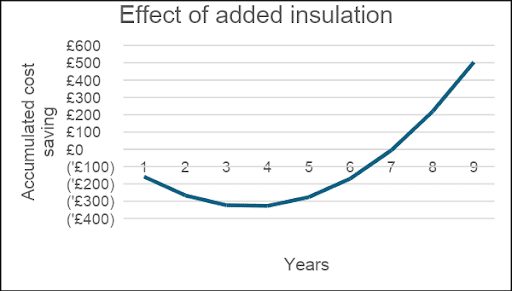
From that point on the heating solution will continue to save money for the life of the building.
As an additional bonus, the return on investment was calculated over a 25 year period. If it had been back-projected it would have generated a return of more than 40 percent a year.
More long-term capital recovery: the forgotten effect of taxation
Another understated advantage for homeowners who invest in domestic renewables such as solar or battery storage is the hidden gains associated with taxation.
Let’s assume you have a total household salary of £40,000. You take £32,320 of this home, after paying 20 percent in tax and National Insurance contribution. In other words, for every £1 you want to take home, you need to earn £1.20.
Now apply this same calculation to a solar panel installation. For every £100 of electricity it generates direct from your roof to your shower, you are not paying an additional £20 in tax.
To put it another way, £100 of energy costs you precisely that: £100, and not the £120 you would have paid for it using conventional fossil fuels funded by your 20 percent-taxed income.
And remember, solar panel installations are VAT-free, meaning you’re actually making a 30 percent saving, depending on your income. So what you actually save is 20 percent plus 20 percent of whatever you subsequently save by having paid for the installation.
Your VAT savings on solar panel installations aren’t just upfront, because by installing solar and no longer paying the additional £20 (£100 not £120 as mentioned above) you are in fact saving the money that you wouldn’t have saved.
The real cost of your retrofit isn’t what it costs to install, it’s what it costs if you don’t.
To book a green assessment of your home, or to save money preparing your property for the future, get in touch with The Green Landlady here.
To share this article, click on the links below.